
 English
 Español
 Pусский
 Français
 Deutsch
 日本語
日本語 한국어
한국어 العربية
 Italiano
Flens van drukvat
A pressure vessel flange is a critical mechanical component used to connect sections of a pressure vessel, attach covers or nozzles, and provide secure access for inspection, maintenance, and cleaning. In industrial systems, pressure vessels are designed to contain liquids or gases under internal pressure, and the flange plays an essential role in maintaining the integrity and safety of the entire assembly. Because it must withstand high pressure, temperature fluctuations, and possible corrosion, the flange is manufactured to strict engineering standards and selected according to the specific service conditions of the vessel.Structurally, a pressure vessel flange is usually a circular ring with bolt holes arranged evenly around its perimeter. It is commonly paired with a matching flange and sealed using a gasket placed between the two mating surfaces. When the bolts are tightened, the gasket is compressed, creating a tight seal that prevents leakage. The quality of this sealing system is extremely important, especially in applications involving steam, chemicals, oil, gas, or other hazardous substances. Even a small leak can lead to operational failure, safety risks, or environmental damage.Pressure vessel flanges are available in several types, including weld neck flanges, slip-on flanges, blind flanges, socket weld flanges, and threaded flanges. Among these, weld neck flanges are widely used in high-pressure applications because their tapered hub provides excellent stress distribution and stronger resistance to deformation. Blind flanges are used to close off openings or vessel ends, while other flange types are selected based on installation requirements, pressure rating, and ease of assembly. The choice of flange depends on design pressure, temperature, material compatibility, corrosion resistance, and applicable industry codes.Materials used for pressure vessel flanges vary depending on operating conditions. Carbon steel is common for general-purpose service, while stainless steel, alloy steel, and other specialty materials are used in more demanding environments. In corrosive or high-temperature applications, material selection becomes especially important to ensure long-term durability and safe performance. Surface finishing, heat treatment, and machining accuracy also influence the flange’s strength and sealing capability.Manufacturing pressure vessel flanges requires precise machining and strict quality control. The flange face must be smooth and accurate to ensure proper gasket seating. Bolt holes must align correctly, and dimensional tolerances must comply with recognized standards. During inspection, tests such as visual examination, dimensional checks, and material verification are often performed to confirm that the flange meets design requirements.In practical use, pressure vessel flanges simplify assembly and disassembly. They allow engineers and maintenance personnel to open the vessel when internal inspection or repair is needed, without cutting or permanently damaging the structure. This makes them highly valuable in industries such as petrochemical processing, power generation, pharmaceuticals, food production, and water treatment.Overall, a pressure vessel flange is more than just a connecting part. It is a key safety and performance component that helps ensure pressure containment, easy maintenance, and reliable operation in demanding industrial environments.
Product
Classificatie:
-
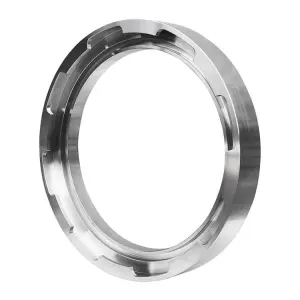
Hoogwaardige drukvatflens voor industriële tank- en apparatuursystemen
Hun classificatie: Standaard flensBekeken: 175Nummer:Release tijd: 2026-07-01 11:18:53Hoge kwaliteit drukvatflenzen zijn cruciale componenten voor industriële tank- en apparatuursystemen, ontworpen om veilige afdichting, hoge drukweerstand en operationele stabiliteit op lange termijn te garanderen. Ze zijn vervaardigd uit koolstofstaal, roestvrij staal en gelegeerd staal en voldoen aan internationale normen zoals ASME Sectie VIII en ASTM-specificaties. Deze flenzen worden veel gebruikt in de olie- en gassector, de petrochemie, de energieopwekking, de chemische verwerking en de maritieme industrie. Met precisiesmeedwerk en CNC-bewerking leveren ze uitstekende duurzaamheid, corrosieweerstand en betrouwbare prestaties onder extreme omstandigheden, waardoor ze essentieel zijn voor veilige en efficiënte drukvatoperaties.
Nieuws
Classificatie:
-
[industry news]Standaardflens voor industriële pijpleidingverbindingssystem...
2026-07-14 03:36:38 -
[industry news]Carbon Steel Neck Flange for Pressure Vessel Systems
2026-07-26 03:41:28
Geval
Classificatie:
Geen zoekresultaten!
Video
Classificatie:
Geen zoekresultaten!
Download
Classificatie:
Geen zoekresultaten!
Werving
Classificatie:
Geen zoekresultaten!
Aanbevolen producten
Geen zoekresultaten!



 WhatsApp
 Telefoon